Corridor read
Long-Tailed Tit – The Flying Teaspoon
Happy Tuesday, happy July, and happy birthday to me! For this year’s birthday, I wanted to dedicate my monthly bird blog to a bird I absolutely adore. That meant rushing around to photograph them before the special day arrived. Their appearance is unforgettable, but these tiny birds are incredibly energetic and rarely stay still for more than a moment, as you’ll soon discover. This month’s featured bird is the Long-tailed Tit (Aegithalos caudatus (rosaceus)), known in Irish as Meantán earrfhada.
Sienna Hayes
Temple note
Layer tip
The full corridor digest continues below along soft meter ticks.
Path
Temple Corridor
Happy Tuesday, happy July, and happy birthday to me! For this year’s birthday, I wanted to dedicate my monthly bird blog to a bird I absolutely adore. That meant rushing around to photograph them before the special day arrived. Their appearance is unforgettable, but these tiny birds are incredibly energetic and rarely stay still for more than a moment, as you’ll soon discover. This month’s featured bird is the Long-tailed Tit (Aegithalos caudatus (rosaceus)), known in Irish as Meantán earrfhada.
A tiny bird hidden among the trees
Imagine standing at a quiet bus stop beneath a canopy of broadleaf trees. Sunlight filters through the leaves, creating shifting patterns that dance like reflections on water. The gentle buzz of insects mixes with the distant sound of a lawn mower, and suddenly a delicate, high-pitched melody catches your attention. The sound is light and bell-like, almost impossibly sweet.
You look upward and notice a small face peeking through the branches. A round little bird sits at the end of a remarkably long, thin tail. Then another appears. And another. Soon, the trees seem filled with tiny fluffy creatures, like floating blossoms, moving together while filling the air with their cheerful calls.
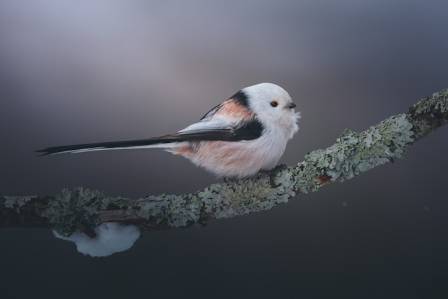
I have been waiting for the chance to write about these adorable strawberry-colored songbirds. Although there are many different subspecies of Long-tailed Tit around the world, the rosaceus subspecies found in Ireland and the UK has a delicate pinkish, eggshell-like coloring. The species itself has a huge distribution, stretching across Europe and Asia, including regions such as Japan and Siberia.
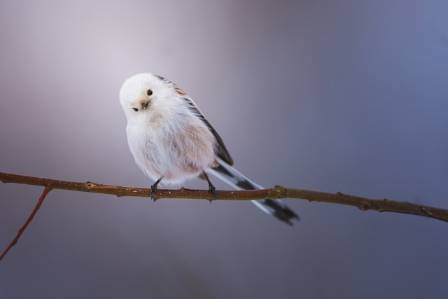
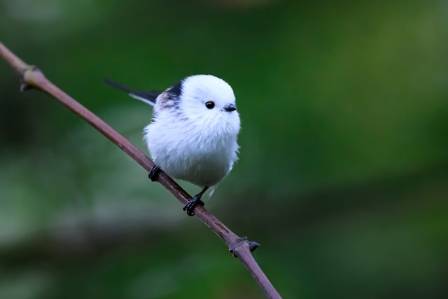
You may have seen photographs of the famous Japanese subspecies, known as Shima-enaga, which has a completely white face and is often called a “snow fairy.” Many people consider these birds among the cutest creatures in the world.
Recognising the Long-tailed Tit
The easiest way to identify these birds is, of course, their extraordinary tail. Their tails can grow to around 7 centimeters long, sometimes exceeding the length of their actual bodies. The tail ends in a tiny fork, giving them an elegant appearance.
If you are lucky enough to see one up close, you might notice their soft apricot-colored eye markings. Bird lovers often debate how to describe their facial pattern. Some see a white crest sitting on a black head, while others think they look like a white-faced bird wearing thick black eyebrows. After looking at these little birds, you can decide which description fits best.
Their lightweight bodies and incredible balance also make them fascinating to watch. They can cling upside down from thin branches and dangling twigs, using their long tails as support while searching for food.
Not actually a true tit
Despite their name, Long-tailed Tits are not closely related to familiar birds such as Blue Tits or Great Tits. Instead, they belong to the bushtit family, a group known for their small bodies, long tails, and short pointed beaks.
Their sharp little beaks are perfect for picking tiny insects and their eggs from branches. Long-tailed Tits especially enjoy eating moth and butterfly eggs. If insects must become part of a bird’s diet, these tiny hunters certainly choose some of the prettiest ones.
Their names throughout history have been just as unusual as their appearance. In the past, they were sometimes called “bumbarrels” or “bum-towels,” although the reason behind these strange names remains a mystery. Some people also call them “flying teaspoons” because of the shape they create while flying. Other old-fashioned nicknames include bottle-tits, mumruffin, and poke pudding. They certainly have no shortage of amusing names.
A bird that travels as a family
The first time I saw Long-tailed Tits was while waiting for a bus. A group of around five birds was flying between the branches above me, and I was amazed. I had never seen pink-colored birds living in the wild in Ireland before. While our usual brown and grey birds deserve appreciation too, these little rosy birds were impossible not to notice.
Since that first encounter, I have noticed that Long-tailed Tits are almost always found in groups. They often travel in family groups of three or more birds, though flocks can sometimes contain around 17 individuals.
Their social groups are fascinating. A typical family may include parents, their grown offspring from previous breeding seasons, and other adult birds that help raise younger chicks. For Long-tailed Tits, raising a family truly takes a community.
The importance of helpers
Helping behavior is common among Long-tailed Tit groups. These helpers are usually adult birds that failed to successfully raise their own chicks that year, often because their nests were destroyed by predators.
Instead of attempting another breeding attempt immediately, they assist other parents in caring for their young. It seems like a heartwarming act of generosity, but there are also practical benefits. Helping gives these birds valuable experience and improves their chances of finding better mates and territories during future breeding seasons.
For bird photographers, these family groups are also a gift. A single Long-tailed Tit can move incredibly quickly from branch to branch, making it difficult to capture a good photo. Watching the whole group together often makes it easier to appreciate their behavior and movements.
Master builders of the bird world
Long-tailed Tit nests are among the most impressive examples of bird engineering found in Ireland. These tiny birds collect four main materials: moss, lichen, feathers, and spider egg cocoons. The combination sounds almost like ingredients from a magical recipe.
Building a nest requires thousands of individual pieces. A typical nest may contain more than 6,000 collected materials. The birds create a small rounded structure with a narrow entrance near the top. It resembles a soft grey egg hanging among vegetation.
The nest is usually placed low in bushes such as gorse and brambles, or higher up in the branches of trees. The birds use spider silk and moss to create a flexible woven structure. The moss leaves work like tiny hooks that attach to loops of spider silk, forming a natural version of Velcro that keeps the nest strong.
The outside of the nest is decorated with lichen, helping it blend into the surroundings. Inside, the birds add more than 2,000 feathers to create a warm and comfortable space. Construction can take around three weeks, and the stretchy design allows growing chicks to expand inside without damaging their long tails.
A nest like this sounds so comfortable that someone should create a luxury camping experience based on bird nests. Sleeping in a human-sized version covered with thousands of feathers sounds wonderful.
One of Ireland’s sweetest birds
The Long-tailed Tit is truly one of Ireland’s most charming birds and has become one of my personal favorites. To celebrate my birthday, I am planning to paint my nails pink in honor of their rosy cheeks.
If you ever spot these tiny “flying teaspoons” in the wild, I would love to hear about your experience or see your photos, even if they are blurry. These energetic little birds are not easy to photograph, but every encounter with them feels special.
After all, a birthday cake deserves a tiny flying teaspoon as a guest of honor.
More along this corridor
MID · en

Hiking to the Horseshoe Bend Overlook
The round-trip walk to the Horseshoe Bend viewpoint is about 1.5 miles (2.4 km) along a hardened trail. The route is accessible in accordance with the requirements of the Architectural Barriers Act. Two shaded shelters are positioned along the trail, although there is no shade structure at the overlook itself.
MID · en

Ancient Pyramids Around the World
Egypt is home to more than 100 pyramids, but the Pyramid of Djoser was the earliest of them. It was constructed during the reign of Pharaoh Djoser, from 2630 B.C. to 2611 B.C., as an imposing burial monument for the ruler. Before this period, royal tombs were generally flat-topped mounds constructed primarily from mud. Djoser’s chief architect, Imhotep, introduced a more lasting and visually striking approach with the creation of the step pyramid. The structure consists of six limestone levels, each smaller than the one beneath it, reaching approximately 200 feet into the air. Imhotep was also regarded as a healer and was eventually worshipped in Greco-Roman times as a deity associated with medicine.
MID · en

Embark on a journey beyond boundaries: explore the wonders of Slovenia
Wonders of Slovenia: Located in the heart of Europe, Slovenia is a hidden gem waiting to be discovered. Breathtaking landscapes, rich cultural heritage and vibrant experiences invite adventurous spirits to embark on journeys beyond the limits.
MID · en

Guide to Chinese New Year Traditions and Events (2026): A Day-by-Day Breakdown
You might be curious about the duration of the Lunar New Year festivities. In China, the celebration spans sixteen days, beginning on New Year's Eve and culminating with the Lantern Festival
MID · en

Rabbit Foot Fern Care Guide
Don’t be discouraged by the word “fern” when it comes to these unusual little plants. Rabbit Foot Ferns are a wonderful choice for anyone returning to fern growing or for those who want to learn the basics before becoming a dedicated fern caregiver. Their charming appearance and easy care requirements make them a great beginner-friendly plant.
MID · en

Macau Tower A Landmark Above the Pearl River Delta
Macau Tower rises 338 meters above the city and stands as one of Macau’s most recognizable landmarks. From its observation deck, visitors can take in sweeping views across the Pearl River Delta, the urban landscape, and, on exceptionally clear days, even see toward Hong Kong.